
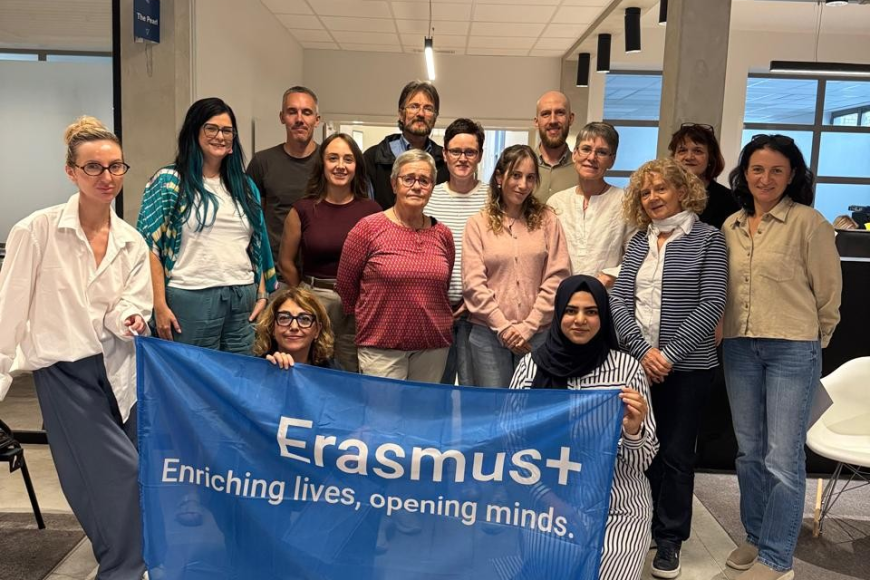
From 16th to 23rd August 2026, teachers Aisling O’Rourke and Cleo Knight travelled to Ghent, Belgium, as part of the College’s Erasmus+ staff mobility programme, undertaking specialist professional development in the rapidly evolving field of Artificial Intelligence in education.
Aisling and Cleo participated in the Advanced Artificial Intelligence for Education course delivered through the Europass Teacher Academy. Designed for educators who already have a foundational understanding of AI, the programme examines how more advanced AI technologies can be meaningfully integrated into teaching and learning while maintaining an appropriate balance between technological innovation and established, human-centred teaching methodologies.
The week provided an opportunity to move beyond simply exploring individual AI applications and instead consider some of the wider pedagogical questions surrounding their use. A particular focus was placed on avoiding over-dependence on AI, balancing online and offline learning, using AI-supported gamification to enhance learner engagement, encouraging creativity and exploring advanced approaches to assessment and feedback.
Through a combination of workshops, group activities and practical sessions, Aisling and Cleo explored strategies for integrating AI while retaining traditional teaching approaches and worked on the development of balanced lesson plans. The programme also examined gamification in AI-supported education, including the creation of gamified learning activities, before moving to the use of AI as a means of fostering student creativity and supporting the design of innovative assignments.
Another important dimension of the course focused on AI-driven assessment and feedback. Participants explored advanced tools that can assist educators with student evaluation and considered how AI-supported assessment approaches might be implemented across different subject areas. The programme concluded with reflection on the competencies developed during the week and the practical application of this learning within participants’ own institutions.
The mobility also offered valuable opportunities for European collaboration and professional exchange. Alongside the formal programme, participants introduced their own schools and institutions, shared educational experiences with colleagues from across Europe and took part in cultural activities in Ghent.
For the College, participation in programmes such as this supports the continuing development of staff expertise in digital pedagogy and Artificial Intelligence at a time when these technologies are having an increasing impact on education, employment and wider society. The knowledge and practical approaches brought back by Aisling and Cleo will contribute to ongoing discussion around how AI can be used responsibly, creatively and effectively to enhance teaching, learning and assessment, while ensuring that the role of the teacher, critical thinking and meaningful human interaction remain central to the learning experience.
The mobility demonstrates the important role of Erasmus+ in providing staff with opportunities to engage with emerging educational practice at European level, develop international professional networks and bring new ideas and approaches back into the College community.